Jazmine Fortes is a third grade educator in the Bay Area. She completed her Bachelor of Arts in Ethnic Studies, with a double minor in Urban Education and Spanish. She has worked to create an equitable, holistic, relative, and empowering curriculum. She considers creating environments in which parents, students, and their community feel welcomed is central to this work. She sat down with us to help us see how she implements these strategies in her classroom.
The pandemic years of Asian American and Pacific Islander (AAPI) Heritage month have been as sobering as celebratory. Last May, in the shadow of the tragic and murderous deaths of spa workers and patrons in Atlanta, and in light of the necessity for a #StopAsianHate campaign, I urged our teaching and teacher community to integrate AAPI histories within their curriculum.
The CHSSP is excited to announce that Tom Adams has been appointed by Governor Newsom to serve on the CHSSP Advisory Board. Currently a Board Trustee for the Davis Joint Unified School District, and formerly Deputy Superintendent of the Teaching and Learning Support Branch at the California Department of Education (CDE), Adams is well versed in history-social science education. Adams holds a Ph.D.
How did women exercise political power before they had the right to vote? This is one question that teachers and students consider as they explore the myriad ways that women led political groups, mounted campaigns for justice, and worked to preserve tribal sovereignty, for example. Now teachers and students have more resources that help fill out the contours of women’s activism in the west. A digital history project, Women’s History in the Pacific West, offers 69 new b
For nearly one hundred years, Americans have celebrated Black History during February. In 1926, during the height of the Jim Crow era in the United States, historian Carter G. Woodson and the Association for the Study of Negro Life and History introduced Black History Week as a week-long celebration during the second week of February. This week coincided with both Abraham Lincoln’s birthday and Frederick Douglass’s birthday celebration.
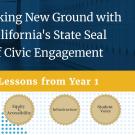
As one of only five states in the nation that offer a high-school diploma seal focused on civic engagement, California has been working to lead the way for students to graduate from high school with a robust civic education. And researchers have been looking closely at how the California State Seal of Civic Engagement (SSCE) has been rolling out since its initial adoption just over a year ago. One of the CHSSP’s close partners, Leveraging E
Editor’s note: In 2018, at the CSMP Lead Learn conference, Executive Director Claudia Martinez presented Gary K. Hart with a special award in recognition of his “many years of leadership, service, and dedication to the California Subject Matter Project.” With his passing on January 27, 2022 we wanted to share her comments as a way to say thank you again to Gary and to hopefully inspire others to continue his legacy of good work and public service.
Last week was our first TK-3rd Grade Group of 2022. The timing of it - the second week after winter break, and in the middle of the Omicron surge - almost convinced us to cancel the Zoom workshop. Teachers did not have any extra time. Everyone seemed to be either sick or running on fumes.
Welcome to Indigenous History Month. Throughout November, resources like Inquiry Sets, picture books, and lesson plans will highlight many ways to incorporate Indigenous history and current topics into TK-12th grade classrooms. Teachers will notice the prominence of Indigenous voices, and the way that scholarship is informing classroom instruction through a focus on themes like agency, resistance, and persistence. Check out the Monthly Highlights page to access the collection.
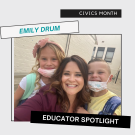
Emily Drum taught history, civics, government, and economics at Monache High School in Porterville, a town in the San Joaquin Valley, where she worked to engage students’ voices.
Passionate about making education relevant and meaningful, Drum emphasized that “When students leave my classroom, they know they can do anything, their voice matters, and they belong.” She recently completed an internship with the California Council on Economic Education, is a fellow at the Facing History
Tuyen Tran, Assistant Director of the California History-Social Science Project, was announced on October 15th as a member of the America250 Foundation’s History Education Advisory Council for a one-year term.
This month, we will turn our attention to civics education. Every two years, we find ourselves in October near the end of the political campaign season. California has no statewide scheduled elections in November 2021, but that does not mean civic engagement stops. Instead, we have a moment to think about our local area, state, and nation outside of the context of an election. A way to do this is to consider the idea of civic learning.
It is highly likely that today’s Afghan evacuees are your students tomorrow, or sometime in the near future. California is presently and historically a magnet for newcomers—immigrants and refugees alike. Fleeing from persecution is just the beginning of a perilous journey towards an unknown destination for safety. That was my family’s refugee experience.